
Coverage Planning
Demand vs. supply, before it's a problem
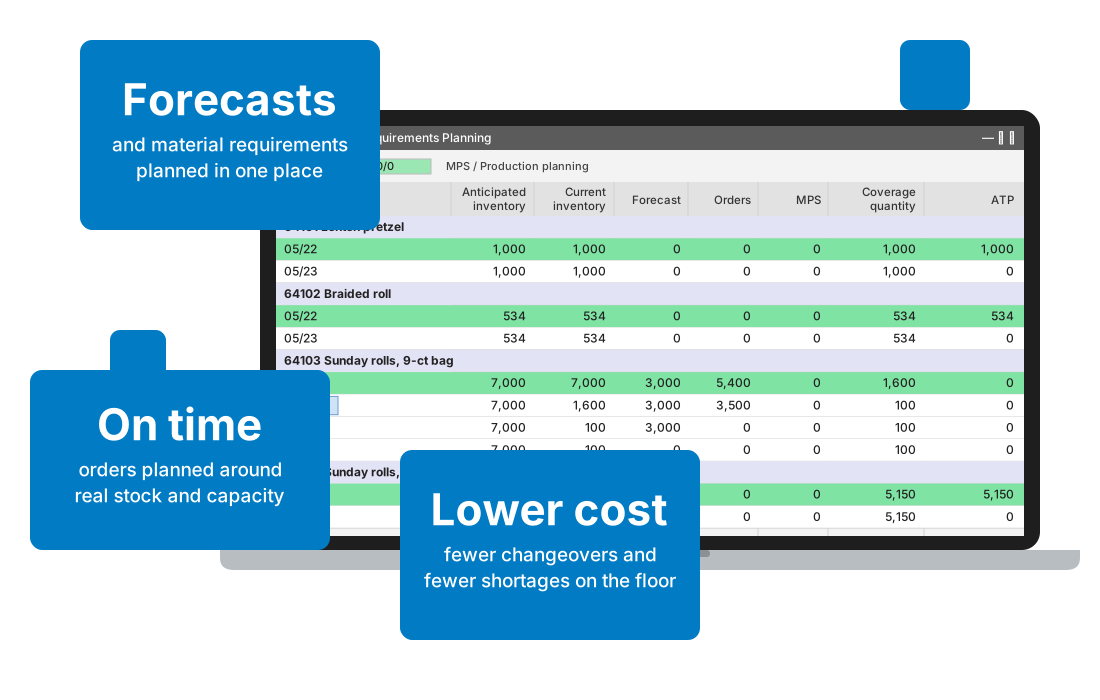
See where supply falls short of demand or policy across the day, week, month, or period view you configure, before it becomes a shortage.
CSB connects demand, inventory, purchasing, production, WIP, and fulfillment in a single system, so the same information used to build the plan is used to run the operation.
Who it's for
Planners build production schedules, assign work to lines and resources, and sequence runs to reduce changeovers and respect plant constraints. Plant managers see what's running, late, blocked, or movable on one board, and controllers see plan-versus-actual and margin feedback once a run closes, so the numbers finance reports match the numbers the floor ran on.


Featured capability: Forecasting and scenario planning
Daily sales forecasts and forward-looking requirements planning give planners a reliable view of what's coming. Test demand scenarios before you commit, and get recommended actions automatically, so you decide with the numbers in front of you, not on the floor.
Planning with CSB-System
Demand vs. supply, before it's a problem
See where supply falls short of demand or policy across the day, week, month, or period view you configure, before it becomes a shortage.
From finished goods back to raw materials
MRP explodes finished-goods demand through your BOMs and yields into raw material, WIP, ingredient, and packaging needs.
Work from demand, or from what you have
Plan from demand back to raw material, or from supply forward to what's left over, while cut trees flag shortages, overages, and idle offcuts.
Know what's available, and what isn't
Real-time stock and WIP by location and lot, so material that's on hold, staged, or in process doesn't show up as available when it isn't.
Schedules built around your constraints
Sequence runs across lines and resources to cut changeovers and respect plant constraints. Fit in short-notice orders and see capacity use by department and machine.
Know how the production plan performed
Compare planned to actual production, yield, and cost once a run closes, so finance and the floor work from the same numbers.
Production Planning and Control is how CSB connects demand to execution. Coverage Planning, material requirements, production orders, inventory and WIP, and costing all run on the same records for planners, plant managers, and controllers.
Coverage Planning tests demand (forecasts, orders, or par levels) against current and projected stock. When coverage goes negative, you get the production, purchase, transfer, or material-requirement action needed to cover the shortfall, built from the same data your plant runs on.
Yes. Daily sales forecasts and forward-looking requirements planning feed the same plan your team runs. You can test demand scenarios and get recommended actions before you commit.
Generic planning tools assume stable, uniform outputs. Food planning starts with uncertainty: yields change, one input becomes multiple outputs, and inventory can exist but still be unavailable. CSB's planning runs on the same records used for traceability, quality release, and costing, so those realities show up in the plan instead of being discovered on the floor.
Multi-stage production with work-in-progress, disassembly where one input becomes several products, and packaging runs. The plan accounts for variable weight, yield variation, co-products and by-products, and shelf life, so it fits meat, poultry, seafood, dairy, and bakery operations.
Yes. Production Planning and Control runs on the same CSB ERP and MES records used for inventory, quality, and costing, so the plan and the plant share one data model.
Timelines vary by scope. The CSB team that designs your system is the same team that implements it. Ask your Plant Review team for a timeline specific to your plant.